



News & Events
PROCEEDINGS
Mobility Data Days 2024
5-6-7 November
Turin – ITALY
The key numbers of the third event of NAPCORE:
– 230 registered delegates
– 33 countries represented
– 3 Strategic Sessions
– 19 technical sessions
| Speakers | 5th November 2024 – Strategic Sessions |
| Damaris Anna Gruber | Future of NAPCORE |
| David Schoenmaekers | Mobility as a Service |
| Timo Hoffmann | Safety Related Traffic Information / Data For Road Safety |
| Speakers | 6th November 2024 – Technical sessions |
| Laura Babío, Victoire Champenois, Annika Degen, Sabrina Ropp | Data provision in urban and regional areas | Regulatory frameworks and practical implications Recent revisions of key regulatory frameworks on the European level (ITS Directive and its Delegated Regulations, TEN-T Regulation, Data Act) go along with increased effects on and requirements for cities and regions in terms of data provision and digitalisation. In this session, representatives from the European Commission, POLIS, EMTA, UITP and the City of Vienna will explore what these regulatory frameworks imply for cities, regions and public transport. Focus will be set on how responsibilities on different geographical and jurisdictional levels can be untangled, how regulations are implemented in practice and how awareness for the National Access Points can be raised and added value for the local level can be created. |
| Peter Lubrich, Sara Linhas, Benjamin Witsch, Mario Scrocca, Ed Ooms, Kenneth Sørensen | Metadata in action: Update on mobility DCAT-AP This session presents the progress of development and deployment of mobility DCAT-AP, the new metadata specification for NAPs and other mobility data portals. |
| Masi Massiliano, Knut Evensen, Bard de Vries, Paal Aaserud | Cybersecurity of NAPs This session gives a short introduction to cyber security and the current work done in WG4 Data Exchange Standards. Some hypothesis/questions will be presented and discussed. The goal for the session is to identify key topics for Napcore X. |
| Cristina Buraga, Mirelle Peters, Samuel Pierce, Jørgen Wanscher, Tu-Tho Thai, | Explore use cases for cycling data standardisation Several workshops co-organized with Polis provide an opportunity to exchange with representatives of the member network on their needs in terms of cycling data. This led to collect use cases from cities and regions in order to analyse the relevant data types for functional requirements and technical standardisation. The results of the joint discussions will allow to define the areas of cycling work for stakeholders in the future project. |
| Dimitrios Gkatzoflias, Johan Scholliers, Lucie Kirstein, Timo Hoffmann | NAPs in the European Mobility Data Space The common European mobility data space (EMDS) aims to create a unified framework for data sharing across various transport ecosystems and platforms in Europe. National Access Points (NAPs) are a critical component of this vision, specifically focused on making data available as required under the ITS Directive. This session will explore how NAPs contribute to the broader EMDS by providing essential data and how the EMDS interlinking layer could ensure more and more mobility data ecosystems are being interconnected to ensure smooth cross-border exchange and use of information. By joining efforts, both NAPCORE and deployEMDS aim to overcome the current fragmentation in mobility data, working towards a more interconnected and efficient European transport system, spanning the local, national and European levels. Participants will also gain insights into the strategic frameworks, technical standards, and long-term governance models that are being conceptualised to guide the EMDS and NAPs towards a more unified, interoperable future. |
| Brede Dammen, Jorge Gonzalez, Tu-Tho Thai, David Ariño Montoya, Maxime Siret | Strategies for NAPs to maximize MMTIS data consumption – Interactive workshop The revised MMTIS DR introduced data quality as a lever to make sure that data exposed on NAPs are actually used (or consumed). But, data quality has lots of different meanings. Are we referring to compliance to data standards, completeness of the data or its capacity to be used by data consumers? Are we also discussing the match between data and real-life? And, how are all of this supporting the maximization of MMTIS data consumption? Let’s have an interactive workshop to explore how National Access Points (NAPs) can enhance the use of MMTIS data through best practices, tools, and strategies to improve data accessibility. We want to foster collaboration and drive innovation in mobility services, as all participants are facing the same questions. Let’s also learn from each other and make sure resources are not wasted re-inventing the wheel. There is no need for participants to be experts in MMTIS data standards. |
| Bard de Vries, Kjersti Leiren Boag, Paal Aaserud | Meet METR: Introduction for policymakers on Management of Electronic Traffic Regulations Shaping the future of trusted data driven mobility is the key of this session, aimed at policy and decision makers in the realm of traffic rules and traffic regulations. Making sure that in the digital era, the end users either being human drivers or automated vehicles, have trustworthy access to the digital rules of the road (both static and dynamic) requires a standardised interoperable ecosystem of roles, responsibilities and technology. This challenge is not only European, but requires a global approach. In this session we will, together with the US DoT clarify the collaboration on the work that needs to done on global, european and local level. Especially the European setting of a NAP centric data ecosystem (in combination with the EMDS) needs to be shaped in the global context. Several domains of expertise are required to make the European requirements clear and engineered to fit in (and develop) the global setting. |
| Frank Daems, Nigel Williams, Dirk Penasse | Ensuring quality parking data on NAPs This session gives an update on the status of the co-operation agreement between EPA (European Parking Association and NAPCORE) , especially focused on the alignment on the common functional profiles. The discussion on the topic will further detail the roadmap for parking data publishments on NAPS. A second part of the session is devoted to secure parking and the SSTP (Safe and secure truck parking ) delegated regulation 885/2013 and the role of NAPS. |
| Petra Soederqvist, Fabrizio Arneodo, Laura Babio, Yves Amsler | Future of NAPCORE: Addressing the MMTIS topic In this session we will explore different MMTIS and ITS topics that will become of increasing importance in the future of NAPCORE. The topics of the presentations will range from the future stream of data from regions and localities in the National Access Points to the publication of standards that will handle observed data (OpRa). The session will conclude with a Q&A to address the questions that might arise. |
| Peter Lubrich, Anastasia Founta, João Montenegro, Petr Bures, Chrysostomos Mylonas, Stavara Maria | Quality frameworks for NAP services and data This session presents the progress of Quality Frameworks, elaborated in the Quality Working Group of NAPCORE. |
| András Selmeczy, Ruud van den Dries, Benjamin Witsch | Data on Alternative Fuels In this session we will showcase the current proceedings regarding AF data accorind the 2023/1804 and the upcoming delegated regulations. Main topics: – Feedback since the 2023/1804 has been published – Delegated regulations and amendments in progress – NL implementation – Work with the commission / STF group – AF demonstrator concept (teaser) – Brainstorming session: Common API in the EU for AF? Preferred data exchange formats? |
| Sylvain Belloche, Bard de Vries, Emmanuel de Verdalle, Jean-Philippe Méchin, Cristina Buraga | Alignment and harmonisation of data exchange standards Introduction of the work achieved, including with external stakeholders such as EPA, review also by UITP. DATEX II / TN-ITS: news about the merging of the 2 standards. Parking data: elaboration of European regulated profiles, in collaboration with EPA. Relation between metadata and domain standards: first thoughts following the release of mobilityDCAT-AP. Cycling data: what do you expect from WG4? Next steps and discussion: update of the roadmap (calendar), debate about missing tasks on the roadmap. |
| Speakers | 7th November 2024 – Technical Sessions |
| Maria Stavara, Chrysostomos Mylonas, Jan Vlčinský, Petr Bureš | Navigating NAPs: Content, Service quality and Accessibility Under the ITS Directive The session will cover various aspects of NAPs, including the content required by the amended ITS Directive ((EU) 2023/2661), the advertising of provided content distributions (data catalogues), and the subscription processes, formats, and protocols (including documentation) that ensure the content is legally and technically accessible. It will also address monitoring the quality and accessibility of provided content using the Integrated Quality Management System (InQMS) and visualizing consumed content through EuroRoaSt. Additionally, the session will briefly touch on the costs to operate NAPs and consumer pricing preferences, based on survey results. You will learn how these elements fit together, the current reality as revealed by the DATEX@NAPs study covering all EU countries, and the tools and best practices that can assist in improving NAP operations. |
| Damaris Gruber, Björn Siebert, Alessandra Pipitone Federico, Timo Hoffmann, Benjamin Witsch, Fabrizio Paoletti | Cooperation NAPCORE – ITS Corridor Projects and C-Roads The session will continue on the ongoing collaboration between corridor projects X4ITS, MERIDIAN and MATIS, NAPCORE and C-Roads. Each representative of the projects will provide an status update about ongoing developments of the projects. As starting point, achievements of the cross-corridor cooperation will be presented and why it is so helpful for the corridor projects to have a regular exchange, not only on an administrational level but also a content based experience sharing. With CRoads as newest member of the cooperation meeting, also the results of cooperation between NAPCORE and C-Roads will be outlined and why specifications and standards are so important for the corridor projects and their implementations. Following up, a panel discussion will be held with focus on following topics: How can partners in the corridor projects benefit from the results of the harmonisation projects? How do we get the handbooks/guidelines etc. to partners who are not involved in the harmonisation projects? How can the harmonisation projects benefit from experiences of implementations? How can corridor projects support the introduction of data quality standards? Can corridor projects be used to increase the amount of data provided to NAPs? For concluding the session, a signature ceremony will be held for the signing of the Joint Declarations between MATIS and X4ITS as well as MATIS and MERIDIAN. |
| Lígia Conceição, João Montenegro, Sara Linhas, Christian Rantzow von Huth, Christian Skjetne Berg, Ed Ooms | NAP Interoperability Demonstrators “NAPCORE is dedicated to understanding how to enable better cross-border interoperability and ensure the continuity of ITS Services through the use of NAPs. Looking into different options while fostering Member States’ cooperation around topics of common interest, a specific task was designed to support those concepts to come to life by developing the NAP interoperability demonstrators. These demonstrators serve as tangible examples of how we can bridge gaps, foster cross-border connectivity, and ensure the seamless flow of ITS services. The session offers a thorough overview, including live demonstrations, outlining the key outcomes and the main constraints and challenges encountered by each of the four demonstrators developed as part of this task: 1) Interchange demonstrator; 2) MarketPlace demonstrator; 3) Metadata demonstrator; 4) Alternative Fuels demonstrator.” |
| Annet van Veenendaal, Thomas Mark de Laine, Matthias Unbehaun, Rebeca Joaquin | Alignment on the RTTI implementation: where do we stand and where do we go? Since the last Mobility Data Days (Budapest 2023) a lot has been done on the EU alignment on the implementation of the in 2022 revised Real Time Traffic Information (RTTI) Delegated Regulation (DR) which will go into force as per January In this session Annet van Veenendaal (lead of the RTTI Action Plan of NAPCORE) and Stephanie Leonard (TomTom and chairwoman of TISA) will give an update on the work being done on both public as well as private side ánd together they look forward to next year. Because even though a lot has been achieved so far, there is still more work to do. |
| David Arino Montoya, Jorge Gonzalez Suitt, Fabrizio Arneodo, Matthias Günter, Johan Hammar | Examples of usage of the MMTIS data available in the NAP This session explores practical applications for Multimodal Travel Information Services (MMTIS) data available through National Access Points (NAPs). Experts from different fields and European countries will present examples of how MMTIS data is improving the efficiency of public transport and enhancing the user experience. Participants will gain insights into real-world applications of data-driven solutions in public transport systems. |
| Chrysosthomos Mylonas, João Montenegro, Holger Drees, Petr Bures, Jasper Beernaerts, Kenneth Sørensen, Witsch Benjamin | NAPs’ Levels of Service and Reference Architecture “The NAP ecosystem is highly diverse across European Member States, featuring various typologies, interfaces, and functionalities. Therefore, there is a need for enhanced compatibility and interoperability of NAP features. WG2 of NAPCORE is dedicated to improving interoperability and the Level of Service (LoS) of National Access Points. This session will focus on two key WG2 initiatives aimed at advancing NAP interoperability: 1) The NAP LoS KPI Framework, which establishes common definitions and a harmonized process for assessing the LoS of a NAP; 2) The NAP Reference Architecture, which details both the essential and additional architectural elements within a NAP. The session will begin with an overview of the LoS Framework and the Reference Architecture. Following this, we will have an interactive part, gathering multiple NAP operators to share how they are leveraging these tools to enhance their systems at the national level, and offering the audience a chance to participate in the discussion on advancing the interoperability of ITS services.” |
| Frank Daems, Bard de Vries, Christian Kleine | DATEX II – TN-ITS merger This session gives an update and status on the DATEXII-TN-ITS merger activity within NAPCORE. An insight will be given on the market needs , the technical realizations and the co-operation agreement between DATEX II and TN-ITS communities. Finally a deployment roadmap will be presented and be discussed. |

n. 6 National Access Points presented their activity
– Belgium
– Croatia
– Denmark
– Finland
– Germany
– Slovenia

OVERVIEW OF THE EVENT – Some photos are available HERE

GALA DINNER
6th November, 2024 evening at the Palazzina di Caccia di Stupinigi
As per tradition, all participants were invited to the Mobility Data Days Gala Dinner.
It was held at Palazzina di Caccia di Stupinigi: an elegant and refined atmosphere blended with the historical beauty, creating a unique setting for an unforgettable evening.
Participants had the opportunity to connect and share ideas in a distinguished environment, while enjoying an extraordinary culinary experience enriched with local cuisine. The Gala Dinner included a guided tour of the Palazzina di Caccia di Stupinigi. Some photos are available HERE
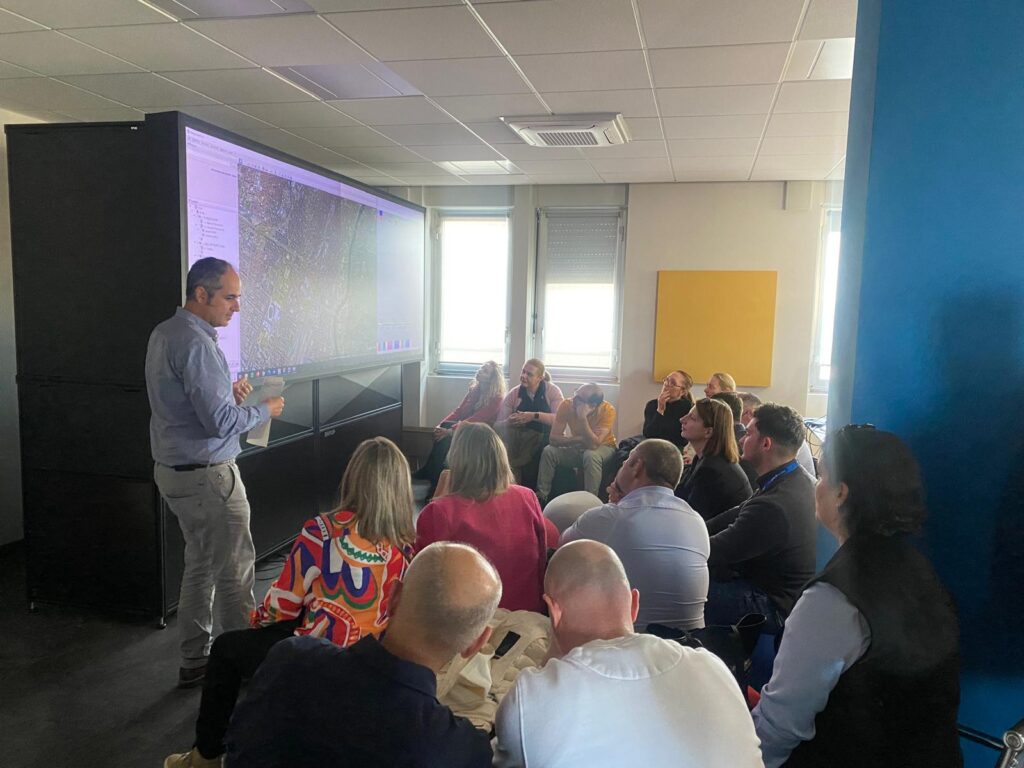
TECHNICAL VISIT
7th November afternoon to the Mobility Center of Turin and Piedmont
The participants had the opportunity to visit a European technological excellence, one of the first in Europe to implement advanced intelligent transport systems for managing public and private traffic.
They explored the technological hub that monitors traffic in real time and offers data collection and processing tools: from Turin’s innovative Limited Traffic Zone to the 35,000 kilometers of regional road network. Turin became a pioneer in Smart Roads and autonomous driving, thanks to this Italian advanced infrastructure. Some photos are available HERE
Session organizers provided the content of this page
For any further information you can contact H.3 Dissemination group – Sabrina Caiani (sabrina.caiani@sina.it).