


News & Events
NAPCORE webinars on Multimodal Data Availability on the NAPs
Task 2.2 organized four webinars.
ENTUR experience: Knowledge sharing Implementation of Multimodal open dataflow
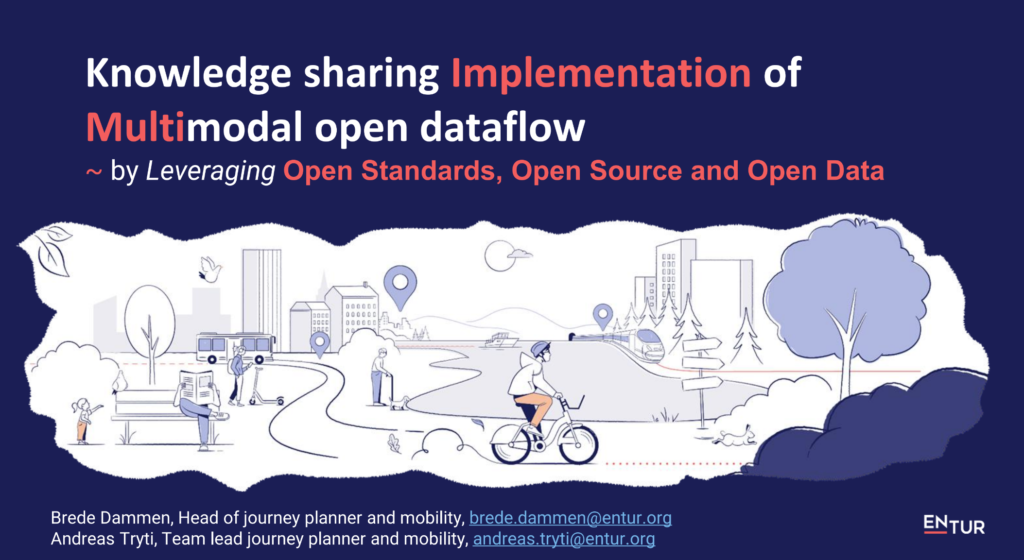
This presentation offers an insight into how MMTIS, open data, and open services have been implemented in Norway. We look at how this was achieved in close collaboration with the transport sector and public authorities, and how — stone by stone — we have built a national infrastructure that the entire sector now benefits from, and that gives travellers consistent, reliable information across the full range of journey planning apps and channels.
Entur is a state-owned company established in 2016 with a mission to “work together to enable simple, sustainable journeys.” As of 2026, it employs ~500 people, of whom ~290 work in digital solution development. The organization operates under a governance structure where the Norwegian Government sets the direction, the Ministry of Transport provides funding and oversight, and the Norwegian Railway Directorate (Jernbanedirektoratet) acts as the intermediary regulatory body. Entur’s work aligns with MMTIS open data requirements, and national transport policies. Brede Dammen, Head of Journey Planner and Mobility, and Andreas Tryti, Team Lead for Journey Planner and Mobility delivered the presentation. Andreas led the technical aspects of the National Journey Planner (NRP) project and integration of data systems.
The video of the webinar is available here on NAPCORE YouTube page.
Fintraffic Experience: Multimodal data availability on the NAP

Finland’s experience was presented by Jaakko Rintamäki as part of NAPCORE Task 2.2 activities. Finland’s MMTIS National Access Point (NAP), accessible at www.finap.fi, was established in mid-2018 as a metadata catalogue rather than a centralized database. Finap was intentionally designed as a metadata network, though it incorporated limited database functionalities to track changes in public transportation, such as new lines, routes, trips, and service reductions. The service was developed against a legislative backdrop that prioritized mostly the National Act of Transport Services (a new framework at the time) and with less importance the MMTIS Delegated Regulation 2017/1926, which mandated multimodal travel information services across Europe.
Finland’s approach fostered an API economy in the mobility sector. The underlying philosophy was that making transport and mobility data—along with sales and booking APIs—publicly available and open without restrictions would increase integrations between market actors and generate new business opportunities. This, in turn, would drive private innovation, reducing the burden on public sector actors to develop new digital and physical services. The vision materialized in the form of numerous MaaS initiatives and pilot projects that emerged following the legislative changes.
The video of the webinar is available here on NAPCORE YouTube page.
OpRa Operating raw data, statistics exchange and common glossary
The Operating Raw Data and Statistics Exchange (OpRa) is a standardization initiative, developed under the CEN/TC 278 committee within Working Group 3, which focuses on public transport standards. Presented by Fabrizio Arneodo, the OpRa Coordinator, as part of NAPCORE T2.2.
OpRa fills a gap in public transport data standards. While NeTEx handles planned data and SIRI manages real-time information, there was no standardized way to exchange operational raw data—the actual, observed events that occur during service execution. This gap made it difficult for authorities and operators to consistently monitor performance, compare metrics across systems, or fulfil regulatory requirements like those in the Multimodal Travel Information Service (MMTIS). OpRa enables performance monitoring, regulatory compliance, and data-driven decision-making across public transport operators (PTOs) and authorities (PTAs).
OpRa enables the structured exchange of historical data. The initiative began as a CEN Technical Report in 2019 and evolved into the OpRa+ project in 2023, funded by the European Commission (EC) to develop a Technical Specification (TS). OpRa will become mandatory for EU Member States once it is published as a CEN Technical Specification and integrated into the MMTIS Delegated Regulation.
The video of the webinar is available here on NAPCORE YouTube page.
Baden – Württemberg mobility data sharing experience at NAPCORE
Last June 30, 2026 Reinhard Otter presented on NAPCORE MobiData BW’s role as a Regional Access Point (RAP), its 6-stage data workflow (aggregation, standardization, and API-based dissemination), compliance with EU standards & regulations, cross-border integration with neighboring regions, challenges and relevance of an aggregation platform for mobility data, and its vision for a unified, open mobility data ecosystem by 2030.
MobiData BW (open data platform for mobility data) is a multi-modal mobility data platform operated by a state-owned company on behalf of the Ministry of Transport of Baden-Württemberg. Its core mission is to serve as a central hub for mobility data, including MMTIS, AFIR (Alternative Fuels Infrastructure Regulation, data on charging infrastructure), public transport, road infrastructure, and shared mobility services. The platform promotes sustainable mobility by leveraging open data and fostering innovation through collaboration with municipalities, transport providers, and private mobility stakeholders.
This experience can contribute to other Member States and their regions to increase data provision and strengthen data processes and relationships with data providers.
The video of the webinar is available here on NAPCORE YouTube page.
The presentation is available here