



News & Events
Major Revision of mobilityDCAT-AP Controlled Vocabularies Released
The NAPCORE Metadata group has recently published mobilityDCAT-AP v3.0.0 as a major update of the popular metadata specification for European mobility data portals. Detailed information about this update is found in a separate news blog.
Controlled Vocabularies ensure consistent metadata populations across different metadata producers
Part of the mobiltyDCAT-AP specification are Controlled Vocabularies (CVs). These provide specific value lists for certain elements in the mobilityDCAT-AP data model, ensuring that metadata producers use consistent, predefined values rather than arbitrary keywords.
Some of these CVs are referenced from external sources, such as the Authority Tables by the Publications Office of the EU. These describe non-mobility related elements such as “frequency” for specific datasets, or “file type” for specific data distributions.
In addition, the mobilityDCAT-AP Working Group has introduced some new CVs to be used with mobility-related elements. These declare specific value lists or taxonomies to be used in the mobility context. A prominent one is the “mobility theme”, a specific subject of the delivered content of a mobility dataset. One value of “mobility theme” is, e.g., the term “Real-time traffic data”, which can be further specified as, e.g., “Traffic volume”. These values can be also easily mapped to the data categories listed under the Regulations of the EU ITS Directive.
The mobility-related CVs are governed by a dedicated Vocabulary Team within the mobilityDCAT-AP Working Group. The applied processes and tools are similar to the main mobilityDCAT-AP specification. The CV maintenance and version control is organised via an own GitHub repository. The CV definitions are presented in human-readable (HTML) and machine-readable formats (JSON-LD, RDF/XML, N-Triples, TTL).
It is time for a major revision of mobility-related Controlled Vocabularies
Given the continuous popularity of mobilityDCAT-AP, with many deployers across Europe, the mobility-related CVs are also increasingly coming into focus. This resulted in some need to review and improve the present CVs, considering specific feedback by the mobilityDCAT-AP community.
The mobilityDCAT-AP Vocabulary Team has now completed a major revision of the mobility-related CVs supporting mobilityDCAT-AP v3.0.0. The work addresses issues and proposals collected through GitHub and ensures that the vocabularies better reflect the terminology required by National Access Points and other mobility data platforms.
Their coordinated release with mobilityDCAT-AP v3.0.0 will allow implementers to update the metadata specification and its supporting terminology within the same release cycle.
The revised Controlled Vocabularies in detail
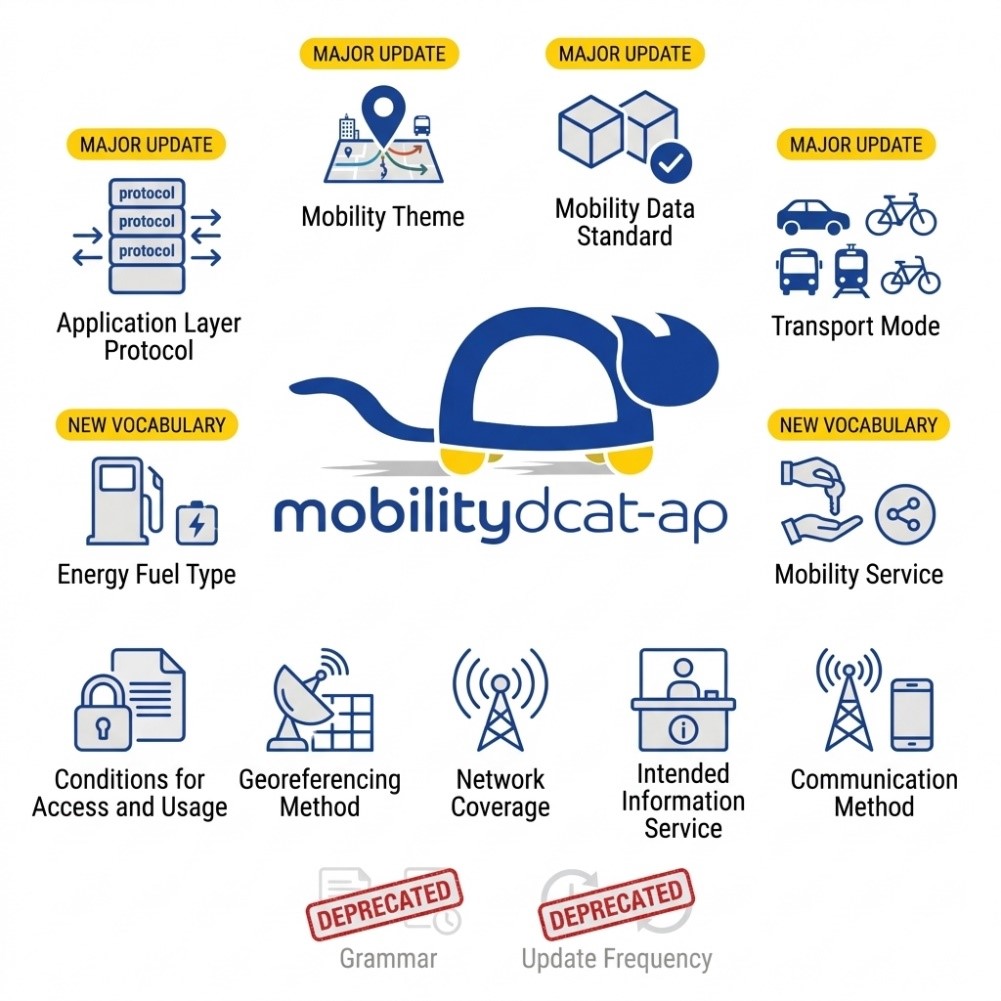
Under the current revision, four existing vocabularies have been updated:
- Mobility Theme 2.0.0 introduces clearer concept names, reduces overlapping among values, improves the organisation of mobility data categories, and directly references European legislations associated with the provision of categories.
- Transport Mode 2.0.0 focuses more clearly on means of transport, such as cars, bicycles, buses, and trains. Service-related concepts have been separated into the new Mobility Service vocabulary.
- Application Layer Protocol 2.0.0 provides a more precise classification of protocols used to access or exchange data, distinguishing them from data formats and mobility data standards.
- Mobility Data Standard 1.2.0 expands the coverage of internationally used mobility data standards, enabling platforms to describe their datasets more accurately.
As part of the updates, certain terms have been deprecated but are still available in the documentation of the respective vocabulary with the specification of the new value that is recommended as a replacement.
The revision also introduces two new CVs:
- Energy Fuel Type 1.0.0, supporting the description of energy and fuel types and considering the terminology and data requirements introduced by the Alternative Fuels Infrastructure Regulation (AFIR).
- Mobility Service 1.0.0, distinguishing means of transport from the services through which they are provided. For example, a bicycle is a transport mode, while bike sharing or bicycle rental is a mobility service.
In addition, the Grammar vocabulary has been deprecated following the deprecation of the corresponding property in mobilityDCAT-AP v3.0.0. The vocabulary will remain accessible and clearly marked as deprecated to preserve backward compatibility.
The new list of controlled vocabularies is documented within the mobilityDCAT-AP specification and in the related GitHub repository. Previous versions remain accessible at versioned IRIs (e.g., https://w3id.org/mobilitydcat-ap/mobility-theme/1.1.1) for backward compatibility.
The vocabularies are openly maintained through GitHub and published under the Creative Commons Attribution 4.0 International licence. This transparent and collaborative process allows mobility stakeholders to report issues, propose new terminology, and contribute to future revisions.